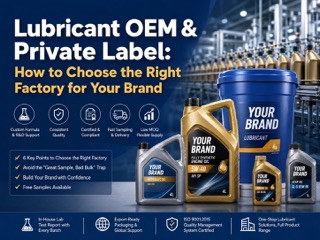
Building your own lubricant brand sounds daunting — but the hard part isn't the formula. It's finding a factory that will take your volume and make every single batch consistent. For distributors, traders, and agents moving from "selling someone else's oil" to "selling their own brand," the wrong factory damages your reputation before the brand even gets off the ground.
This article skips the fluff and covers just two things: how lubricant OEM / private label actually works, and the six points you should really focus on when choosing a factory.
What OEM and private label mean in the lubricant industry
In the lubricant industry, OEM (contract manufacturing) and private label often refer to the same thing: a factory produces oil on proven formulas and lines, then labels it with your brand, your packaging, your label. What you receive is a finished, market-ready product carrying your own logo — without having to build your own plant, lab, and supply chain.
This is fundamentally different from "buying drums and repackaging." A proper contract manufacturer delivers a complete capability stack — formulation, production, filling, testing, certification. You control the brand, pricing, and market; the factory owns quality consistency and compliance.
Why more brands start with contract manufacturing
- The profit stays with you. Replacing imported big-name brands with your own label gives you a noticeably wider margin through the same channels — exactly why so many agents move from "reselling" to "own brand."
- Low upfront cost, fast iteration. With no line or lab to build, a new product can go from sample to shipment in weeks, not years.
- The engineering risk is already proven. Base oils, additive systems, and filling processes are field-validated by the factory — you don't carry the risk of a formula failing from scratch.
The six things that really matter when choosing a lubricant factory
Every factory's website claims "great quality, great price." But before you place an order, these six dimensions are what actually decide whether your brand succeeds.
1. Does the MOQ match your stage
This is the first wall small brands hit: large factories usually won't take small orders, yet your brand's early volume is often modest.
What an early-stage brand really needs is a flexible factory — one willing to accommodate small runs and able to supply large ones.
Ask directly: What's the minimum order quantity? Can a single product category be ordered on its own? Will they do a small trial run for a new product? A factory that only quotes for large orders keeps your brand stuck at the starting line.
2. Can the formula be customized, or only standard products
Many contract manufacturers will only label a standard formula for you. But if you want differentiation — performance tuned for a specific machine, operating condition, or market — you need a factory with formulation and R&D capability.
Bodi's approach: blend primarily on refined base oils from Sinopec and Formosa Plastics, complemented by additives from Lubrizol, Infineum, Chevron, Afton, and BASF, with applied R&D backed by a partnership with the Automotive Tribology research institute at South China University of Technology. That means you can move from an oil that "works" to one that's "tuned specifically for your customers." For the customization process and MOQ policy, see our OEM & private-label service.
3. Batch consistency — a hundred times more important than "a good sample"
The biggest trap in contract manufacturing is "the sample is one product, the actual delivery is another" — a bait-and-switch. Your end customer's first batch works, the second fails, and your brand takes the hit.
Two things tell you whether a factory is consistent: whether it has its own lab (rather than outsourcing tests), and whether it provides a test report with every batch. Bodi runs a fully-equipped in-house lab — kinematic viscosity meters (100°C / 40°C), flash-point testers, low-temperature dynamic viscosity, demulsibility and foam-resistance instruments — and ships a verifiable test report with every batch. For you, that's the proof you can hand to your end customers.
4. Certification and compliance — can you actually enter your market
To put a private label into formal channels, bid on contracts, or export to overseas markets, certification is a hard requirement. The baseline is a quality-management-system certification (such as ISO 9001); exporting may also involve the destination country's labeling and regulatory requirements.
Bodi has held ISO 9001:2015 quality management system certification (covering the production and sale of lubricants) since 2016, and customizes packaging to the local-market language and labeling regulations for overseas clients. When choosing a factory, confirm its certifications cover the channels and countries you intend to enter.
5. Sampling and lead time — can they keep your pace
Nothing hurts a brand like waiting. You need to know: How long for a sample? What's the bulk lead time? Will it slip in peak season?
A useful benchmark: Bodi typically tunes and delivers a sample for testing within two days, ships domestic bulk orders in about 7 days and overseas orders within a month, and keeps roughly 50% spare capacity to absorb peak-season swings. Get these numbers straight before you hand your brand to anyone.
6. Is the catalog complete — can one factory cover it all
If your brand carries more than one oil (say diesel engine oil, hydraulic oil, gear oil, and rust preventive all at once), splitting them across multiple factories makes quality control and supply chain enormously complex. A factory with full category coverage dramatically simplifies management.
Bodi's product line spans the full range — internal-combustion engine oils (gasoline and diesel), hydraulic oils, industrial and automotive gear oils, slideway oils, turbine oils, heat-transfer oils, compressor oils, quenching oils, emulsified cutting fluids, and rust preventives. One supplier, one quality standard, one point of contact can carry your brand's entire product line. Browse our full lubricant product range to see which categories could fit your brand.
Free samples: validate before you order
A proper contract manufacturer should let you validate first, order second. Bodi provides free samples (you cover the shipping), so you can run your own tests, compare against your existing product, and confirm performance before committing to a bulk order. This step directly removes the biggest worry — that the sample and the bulk won't match.
Validate quality and differentiation with a free sample, confirm you can deliver a better product to your end customers, and only then talk volume — that's the right order of operations for minimizing brand risk.
How to decide
If you're planning the first run of your own lubricant brand, turn the six points above into a checklist and put each one to your candidate factories: MOQ, formula customization, batch consistency and test reports, certification, sampling lead time, and category coverage. Only a factory that gives clear, verifiable answers on all six deserves your brand.
Since 2016, Bodi has focused on the R&D, production, and contract manufacturing of high-value lubricants — running its own brands (Qiumingshan, SUPER AEGIS, Vabolion, and more) while providing OEM / private-label services to brands at home and abroad. One brand we manufacture for has grown to a steady monthly order volume of 70–80 tons. Whether you're an early-stage brand validating the market or an established distributor expanding your line, we can work with you.
Need a sample made for your brand? Reach us on WhatsApp (+86 15914570351) or email (anson@bodilube.com) — tell us your target market and product requirements, and our technical team will design a tailored solution for you. To dig into our manufacturing capabilities first, see the OEM & private-label service details.